

You can have a warm, connected Christmas with in-laws you share no language with. The trick is to stop aiming for fluent conversation and plan for three things instead: a few messages before you arrive, a handful of rehearsed phrases and shared activities at the table, and a thank-you afterwards in their own language. Your partner is your best translator, but not your only one, and a short, sincere effort in their language counts for far more than perfect grammar.
Picture it: it's 24 December in a living room outside Aarhus. The rice pudding comes out, your partner's dad winks, and everyone at the table bursts out laughing at something you didn't catch. You laugh too, a second late. If that scene makes your stomach drop a little, this guide is for you.
Why is Christmas with in-laws harder when you don't share a language?
Christmas packs a lot into a few hours: long meals, inside jokes, family traditions nobody explains because "everyone knows". When you don't speak the language, you lose the small talk that usually smooths things over, and you can't tell whether a silence is awkward or just comfortable.
It's also tiring. Following a conversation in a language you half understand takes real concentration, and most people hit a wall after a couple of hours. That's normal, not a sign that it's going badly. Planning for it is half the battle.
How can you get to know them before the visit?
The best time to break the ice is weeks before you walk through the door. A first message on Christmas Eve is a lot of pressure; a fifth one is easy.
- Send a short hello now. Something like: "Hi Karen, I'm really looking forward to Christmas with you all. What's your favourite thing about it?" A question gives them something to answer, and you'll arrive with a topic ready.
- Ask your partner for the backstory. Who's the joker, who's shy, what topics are off-limits, which traditions matter most. Five minutes of briefing saves you from complimenting the wrong person's cooking.
- Learn the shape of their Christmas. In Denmark, the main celebration is on 24 December, with risalamande and a hidden almond, and often a dance around the tree. In Spain, Nochebuena on the 24th is the big family dinner, and many families exchange gifts on 6 January (Reyes). Knowing the schedule means you're not the one opening presents a day early.
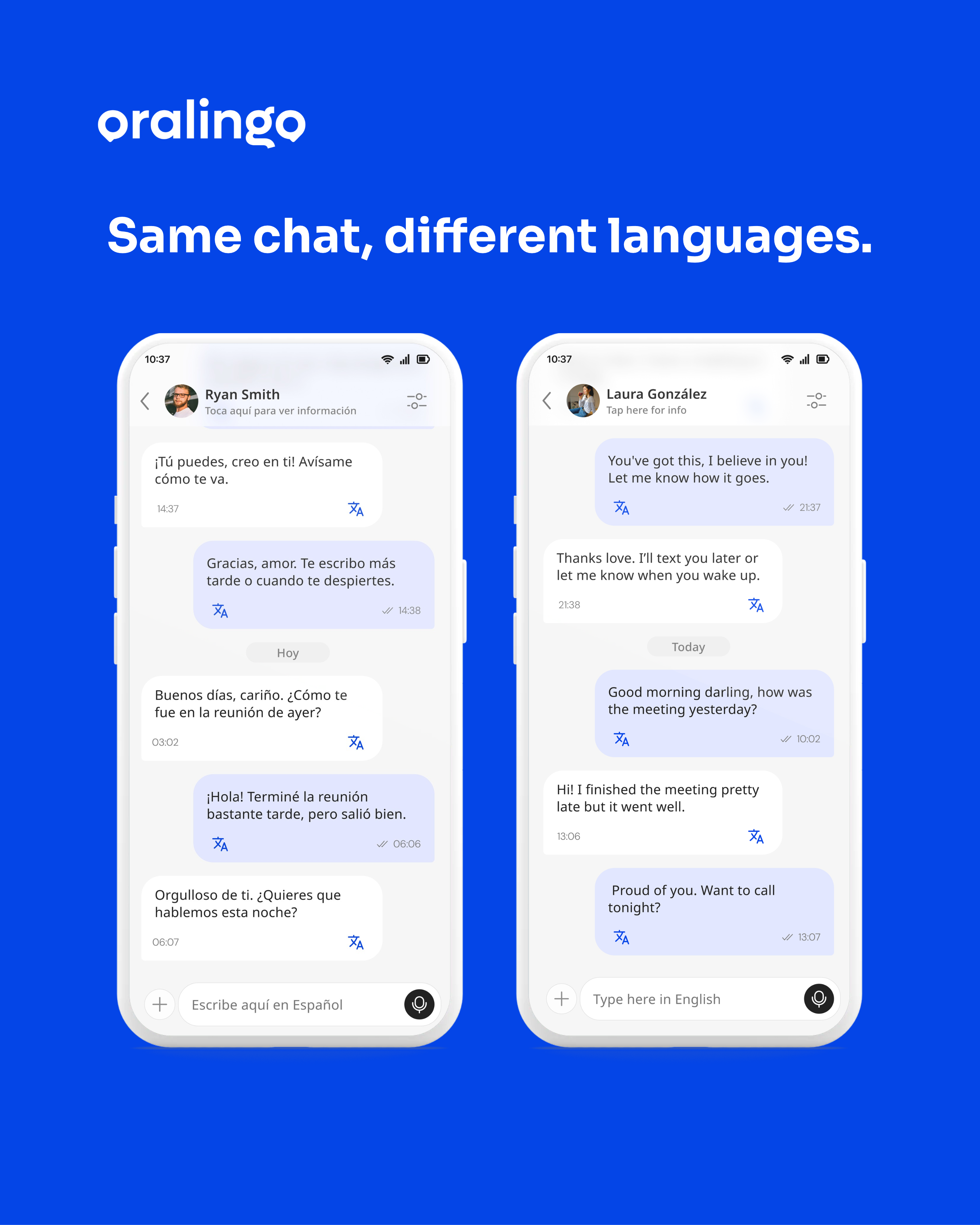
This is where a translating messenger helps. With Oralingo, you and your future mother-in-law each write in your own language, and every message arrives already translated, with nothing to copy and paste. You can also send a voice message, which she can read or hear read aloud in her language. Hearing your actual voice before you meet makes the first hug a lot less awkward. How much you lean on technology is up to you. Some people just want a friendly hello before the big day; others want to really get to know their in-laws. If having translation in your pocket makes you feel more relaxed, use it, and let your own few words do the rest. To get started, send her an invite link from the app.
Which phrases should you learn first?
You don't need a vocabulary list. A handful of phrases you can say without thinking will carry you through most of the evening, so pick the ones that fit and practise them out loud with your partner until they feel natural.
In Danish, that's Glædelig jul (Merry Christmas), Tak fordi jeg måtte komme (Thank you for having me), Det smager dejligt (This is delicious), Skål! (Cheers!) and Jeg er stadig ved at lære det (I'm still learning). In Spanish: ¡Feliz Navidad!, Gracias por recibirme, Está buenísimo, ¡Salud! and Todavía estoy aprendiendo.
"Tak for mad" (thank you for the food) is a small one with a big effect in Denmark: it's what people say when they get up from the table, and hearing it from a guest tends to get a smile. "I'm still learning" is the most useful line of all, because it turns every mistake into something charming instead of awkward.

How can your partner help without becoming a full-time interpreter?
Translating every sentence for hours is exhausting for your partner and makes you feel like a guest at your own Christmas. Agree on a few ground rules before you arrive:
- Summaries, not subtitles. Your partner gives you the gist every few minutes ("They're arguing about whose turn it is to host next year") instead of translating word for word.
- A signal for "help me". A hand on the knee or a raised eyebrow means "please translate this one". Everything else, you ride along.
- Seat them nearby, not next to you. If your partner sits across the table rather than beside you, you'll naturally turn to the people around you instead of just to them.
- Hand them the hard moments. Toasts, serious family news and anything emotional are your partner's job. Small talk about food is yours.
What can you do at the table when words run out?
- Help in the kitchen. Peeling potatoes next to your mother-in-law builds more connection than an hour of halting conversation. Watching and copying is a language of its own.
- Bring something from your own Christmas. A dish, a decoration or a family photo gives everyone something to point at and ask about. Mince pies in Copenhagen or turrón in Manchester are instant conversation starters.
- Play games. Card games, board games and the Danish almond hunt in the rice pudding are ideal: the rules are quick to learn and laughing together doesn't need a translator.
Use your phone for the odd tricky sentence. For face-to-face moments, the translation feature built into your phone or a translation app's conversation mode can help with a word or two. Just keep it brief, because nobody wants the phone at the centre of the table.
- Take a break. Ten minutes on a walk or with the kids recharges your listening brain. Nobody will mind.
What if family members can't be there in person?
Many cross-language families are spread across countries, so the grandparents in Valencia may be watching Christmas Eve through a screen. A video call where nobody understands each other can feel like a lot of smiling and waving.
In an Oralingo video call, you hear each other's real voices, and what each person says appears as translated captions in the other person's language. Captions start a few seconds after you connect and appear as each sentence finishes, so it works best with short sentences and a bit of patience. It's perfect for a quiet catch-up with grandma on the sofa. Our guide to video calling someone who speaks another language has more tips.
How do you keep the connection going after Christmas?
The days after the visit are when relationships with in-laws are really built. A short follow-up shows the effort wasn't just for one night.
- Send a thank-you within two days, ideally as a voice message. Mention something specific: "Your risalamande was the best thing I ate all year" lands better than "Thanks for everything".
- Share a photo from the evening and ask about the recipe or the tradition behind it.
- Keep a small thread going. A message on their birthday, a photo of your attempt at their recipe, a question about a word you heard at the table. Little and often beats one long letter a year.
If you'd like to say how you feel without losing the meaning, our post on expressing emotions with a partner who speaks a different language has advice that works just as well with in-laws.

It doesn't have to be perfect
Your first Christmas with your in-laws probably won't go exactly to plan. You'll mix up a word, miss a joke or two, and maybe say "Skål" at the wrong moment. That's fine. What they'll remember is that you tried: the hello you sent in November, the "Tak for mad" at the end of the meal, the potatoes you peeled together. Maybe next year, when the rice pudding comes out and everyone laughs, you'll be laughing at the same time as everyone else.

